
Blue Lume Glasses Reviews 2026: Can One Pair of BlueLume Glasses Really Cover Reading, Screen, Distance and Sunshine?
👉 Get BlueLume Glasses at 50% off – one pair for near, far & sun »
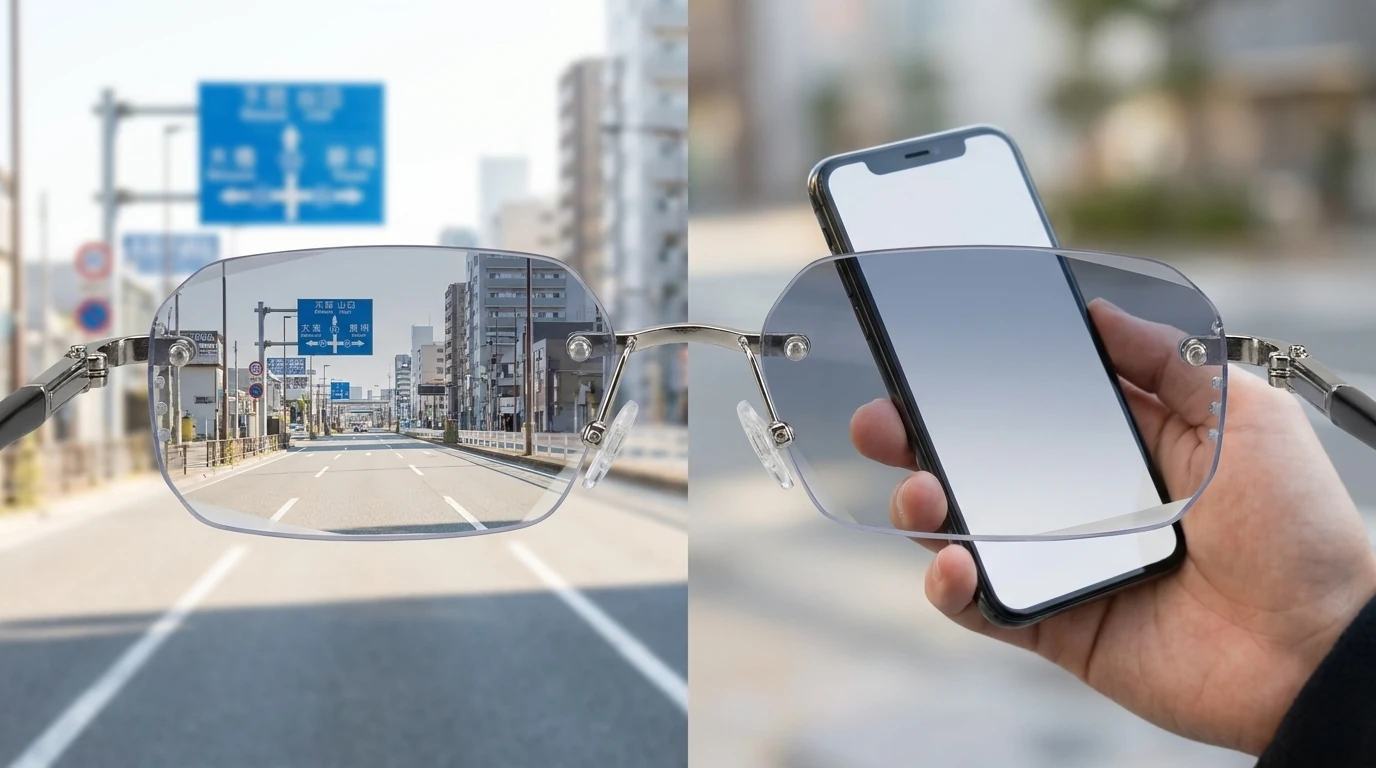
Vendor graphic: the road sign far away and the phone up close in one view – the idea behind BlueLume Glasses.
Blue Lume glasses reviews all circle around one tempting question: can a single pair of ready-made glasses handle the small print on your phone, the spreadsheet on your monitor, the street sign down the block and the bright sun on your porch? BlueLume Glasses – also searched as Blue Lume or bluelume glasses – promise exactly that, according to the vendor: near-to-far viewing, lenses that darken outdoors, a blue light and UV filter, no prescription and nothing to charge. We went through the official product page and FAQ, walked the US order page, read the policies and turned it all into a buyer’s guide built around the situations you face after 40. Our verdict: as one light everyday pair for people without a special prescription, BlueLume is a smart, well-priced choice that earns 8.6 out of 10.
One featherweight pair for reading, screen, distance and sunshine – with nothing to charge
- Score: 8.6/10 (Very good). Top marks for wearing comfort & weight (9.2) and everyday versatility (9.1).
- What it is: ready-made, rimless glasses that, according to the vendor, combine near-to-far viewing, photochromic lenses and a blue light and UV filter.
- How it works: no battery, no electronics – the near-to-far effect comes from the lens itself. The exact lens design isn’t published.
- Who it suits: adults over 40 who are tired of juggling readers and sunglasses and don’t need an individual prescription.
- Best deal: 3 pairs for $119.97 – $39.99 a pair, 55% off according to the vendor; $35.54 a pair in the 5-pack.
- Easy to try: no appointment, dispatch within two business days from a US warehouse (vendor), 90-day money-back guarantee.
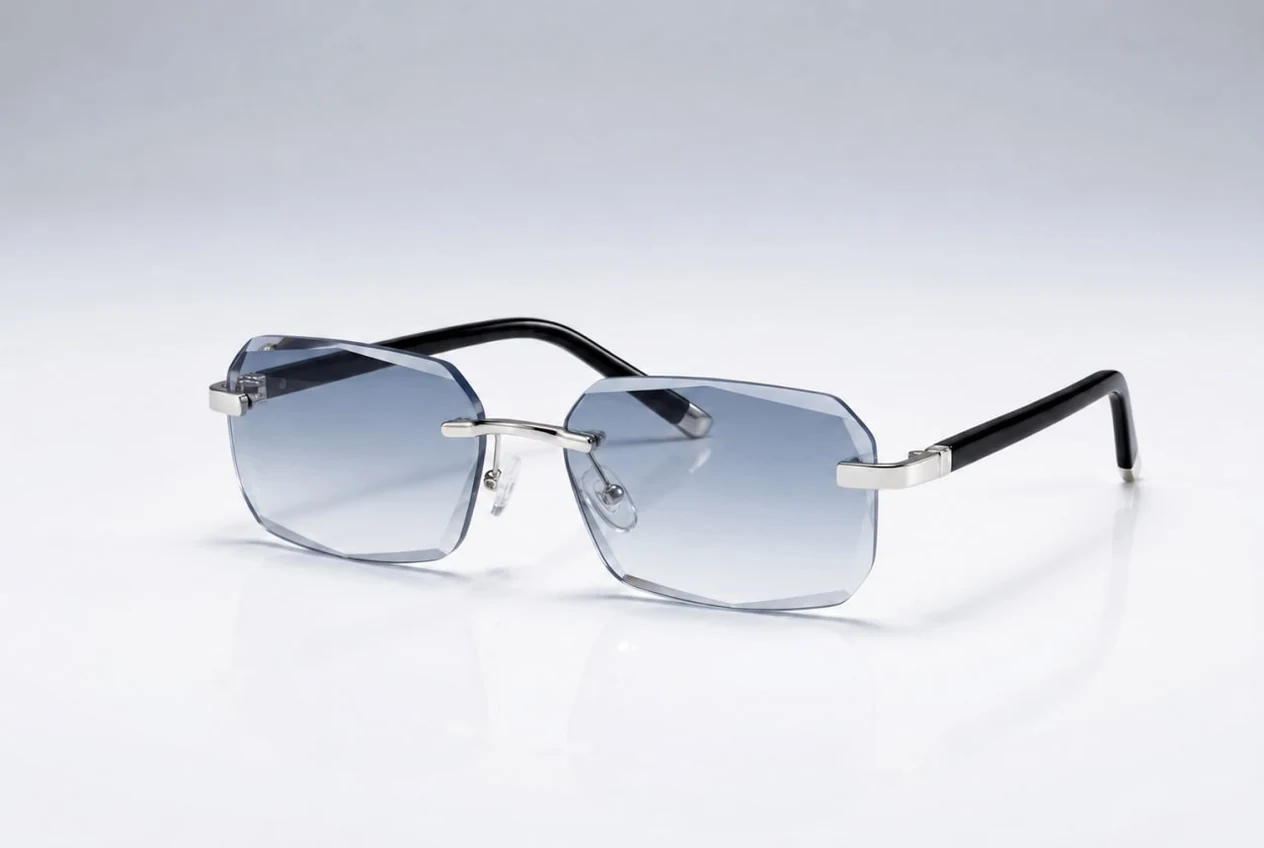
BlueLume Glasses – 2026 version
- Near-to-far viewing in one pair, according to the vendor
- Photochromic lenses: dark in the sun, clear indoors
- Blue light filter plus UV filter (order page)
- No battery – nothing to charge
- Under one ounce, slim rimless frame (vendor)
- No prescription needed to order
- From $44.43, down to $35.54 a pair in the 5-pack
| Assessment period | November 2026; US order page walked on November 17, 2026 |
| Sources reviewed | Official product page and FAQ (US), US order page in US dollars, Terms of Service (shipping), Returns & Exchange Policy, contact and company details |
| Lens information | As published by the vendor; no diopter values, lens design or frame measurements are disclosed |
| Background | General optometry knowledge on presbyopia, multifocal and photochromic lenses and blue light |
| Purchase path | Link → product page → “Order Now. Save 50% Off” → checkout; all five packages selected and the Grand Total read – nothing ordered |
| Photos | Official vendor photos and graphics |
| What it doesn’t include | No lab test, no wearing of our own and no eye exam – we didn’t put the glasses on or measure anything. The score is our editorial assessment. |
- What BlueLume Glasses are
- The 3 + 1 lens jobs after 40
- How “self-adjusting” works
- Decision table: which glasses?
- Screens & blue light
- Transition lenses
- 5-minute try-on routine
- Seven everyday moments
- Driving
- Rimless frame care
- Who they suit
- Our 8.6/10 score
- Reviews & complaints
- Scam or legit?
- Prices & packs
- Ordering & guarantee
- Quick answers (FAQ)
- Our verdict
What Are Blue Lume Glasses? One Ready-Made Pair With Four Jobs
BlueLume Glasses are ready-made glasses – no prescription, no fitting appointment – sold online under the shop brand Lensera. The order page calls the current model the “new, improved 2026 version”. According to the vendor, one pair brings together what usually takes several: near-to-far vision for small print, phone, screen, TV and road signs; photochromic lenses, often called transition lenses, that darken in bright sunlight and clear again indoors; a built-in blue light filter; and, per the order page, a UV filter.

Vendor photo: the slim, rimless BlueLume frame with gradient-tinted lenses.
The vendor describes the lens system as “self-adjusting” and “adaptive”: you put the glasses on and look through them as usual, and when your gaze shifts between near and far, the lens system is meant to help provide the right sharpness. There is no battery and no electronics. The rimless frame weighs under one ounce according to the US product page.
If you’d like a compact summary of the features before you dive into our decision guide, the complete Blue Lume glasses overview is a detailed overview page that collects the key points in one place. Here, we focus on the situations and decisions behind the purchase.
The vendor names plenty of everyday uses – reading, computer work, TV, shopping, walks, commuting, or reading a menu and then looking across the room – and is refreshingly clear about its limits: the footer calls the glasses “a consumer eyewear product, not a medical device” that doesn’t replace a professional eye exam. That’s the frame we use for this check. The glasses are sold through the official BlueLume website in packs of one to five pairs.
After 40, Your Glasses Have Three Distance Jobs – and Light Is the Fourth
To judge any “one pair for everything” promise, it helps to know what “everything” means. Somewhere in your mid-40s, the menu or the text message suddenly needs to be held further away. Eye-care professionals call it presbyopia, age-related farsightedness: the eye’s near focus gradually declines. It happens to almost everyone – and it splits your day into zones that one pair of glasses has to serve.
- Job 1 – near (about 14 to 16 inches): your phone, a paperback, a price tag in your hand. This is where presbyopia shows first and where classic readers do their work.
- Job 2 – intermediate (about an arm’s length): the laptop, the recipe on the counter, the dashboard. The job single-strength readers handle worst – the monitor turns soft, and you lean forward or tip your head back.
- Job 3 – distance: the TV, a face across the room, the street sign. Many people still see well far away, which is exactly why readers get in the way: you look over the top or take them off every few minutes.
- Job 4 – light: bright sun outdoors that sends you hunting for sunglasses, and hours of screen light indoors.
Put the four jobs together and you understand why so many people over 40 end up with a “case collection”: readers on the nightstand, a pair for the computer, sunglasses in the car. BlueLume’s pitch is to cover all four with a single light pair. The rest of this guide shows where that works beautifully, where it has limits and how to find out quickly whether it works for you.
How Do Blue Lume Glasses Work? What “Self-Adjusting” Can and Can’t Mean
Self adjusting glasses, auto focus glasses, adjustable focus glasses, smart reading glasses – the names sound alike but describe two very different technologies. A little physics first: a lens without electronics cannot change its optical power by itself.
The no-battery principle: viewing zones
Glasses that cover near and far without a battery normally use different viewing zones – the principle behind progressive and multifocus reading glasses. In a typical layout you look straight ahead for distance, a little lower for the screen and lower still for reading. Your eyes do the switching by looking through a different part of the lens, and because that happens naturally as your gaze moves, it can feel as if the glasses adjust themselves.
How BlueLume lays out its zones is not disclosed – the vendor publishes no lens design and no diopter values, and our score reflects that. What the lens is not, the FAQ answers in one line:
Electronic autofocus or no-battery multifocus? How to tell them apart
Electronic autofocus glasses use liquid-crystal lenses, a battery and sensors to change their power – a different product class, and BlueLume isn’t part of it. Three quick signs tell you what you’re looking at:
- Charging: a cable, a dock or a battery runtime in the specs means electronic. BlueLume: nothing to charge.
- Temples: sensors and batteries need room, so electronic frames have thicker temples. BlueLume weighs under one ounce (vendor).
- Use: an electronic lens changes its power across the whole lens; with zone lenses you lower your gaze to read and look straight ahead for distance.
So, do Blue Lume glasses really work?
For no-battery models, “do self adjusting glasses really work?” comes down to one thing: do the zones match your eyes and your daily distances? For many people whose near vision has simply changed with age, ready-made zone lenses are a comfortable everyday solution – the progressive principle has been around for decades. For a prescription, astigmatism or different values in each eye, individually fitted glasses remain the right tool. With BlueLume, you find out in five minutes at home (see our try-on routine) – and what makes the pair attractive is the package around the concept: lenses that darken in the sun, a blue light and UV filter, under one ounce and nothing to charge.

Vendor photo: a book up close, the TV across the room – the near-and-far situation BlueLume Glasses are designed for.
Which Glasses for Which Job? Our Decision Table
Before you buy any pair, it pays to see the whole shelf. The table compares categories rather than brands – from the drugstore rack to the optometrist’s chair.
| Option | Price range | Prescription? | Best for | Keep in mind |
|---|---|---|---|---|
| Drugstore reading glasses | Low | No – one fixed strength off the rack | Reading and close work | Distance turns blurry; on and off all day |
| Blue light reading glasses | Low to moderate | No | Reading plus screens at one distance | Still one strength; the filter doesn’t replace screen breaks |
| Multifocus / progressive reading glasses (ready-made) | Moderate | No | Near and intermediate; some are clear on top for distance | Standard strengths, same in both lenses; a few days to get used to |
| Progressive glasses from an optometrist | High – exam plus custom lenses | Yes – exam and individual fitting | Prescriptions, astigmatism, different values per eye | Appointments and waiting time; the most precise option |
| Photochromic (transition) glasses | Moderate to high | Either – prescription or ready-made | Moving between indoors and outdoors | Barely darken behind a windshield; clearing takes a few minutes |
| Electronic autofocus glasses | High | Depends on the model | A lens that changes power electronically | Battery and charging; heavier temples |
| BlueLume Glasses | $35.54–$44.43 a pair (US order page, Nov 2026) | No – no strength to choose | One light everyday pair for near, far, screen and sun | No individual prescription or published diopter data; a few days to get used to |
Where does BlueLume fit? Right between progressive reading glasses and transition glasses: it combines near-to-far viewing, photochromic lenses and a blue light filter that you’d otherwise buy as separate products, at a price close to the drugstore end of the scale. If you have no special prescription and want fewer pairs in your life, it’s the most convenient row in the table. If your eye doctor has given you a prescription, the optometrist row stays your main pair.
Three quick decision rules
- Only small print is a problem and you rarely look up? A plain pair of readers may be all you need.
- You switch between phone, screen, room and outdoors all day? That’s where a multi-job pair like BlueLume saves the most swapping.
- Prescription, astigmatism, different values per eye or a diagnosed eye condition? Eye exam first, then individually fitted glasses.
The Middle Distance: Screens, Blue Light and a 20-Second Habit
Screen work is where many people first notice that readers aren’t enough: the monitor sits too far away for reading glasses and too close to look sharp without them. With any multi-zone lens, the screen’s position matters. Place it about an arm’s length away and slightly below eye level, so you look through the middle of the lens with a relaxed neck. If you catch yourself tipping your head back, lower the screen rather than raising your chin.
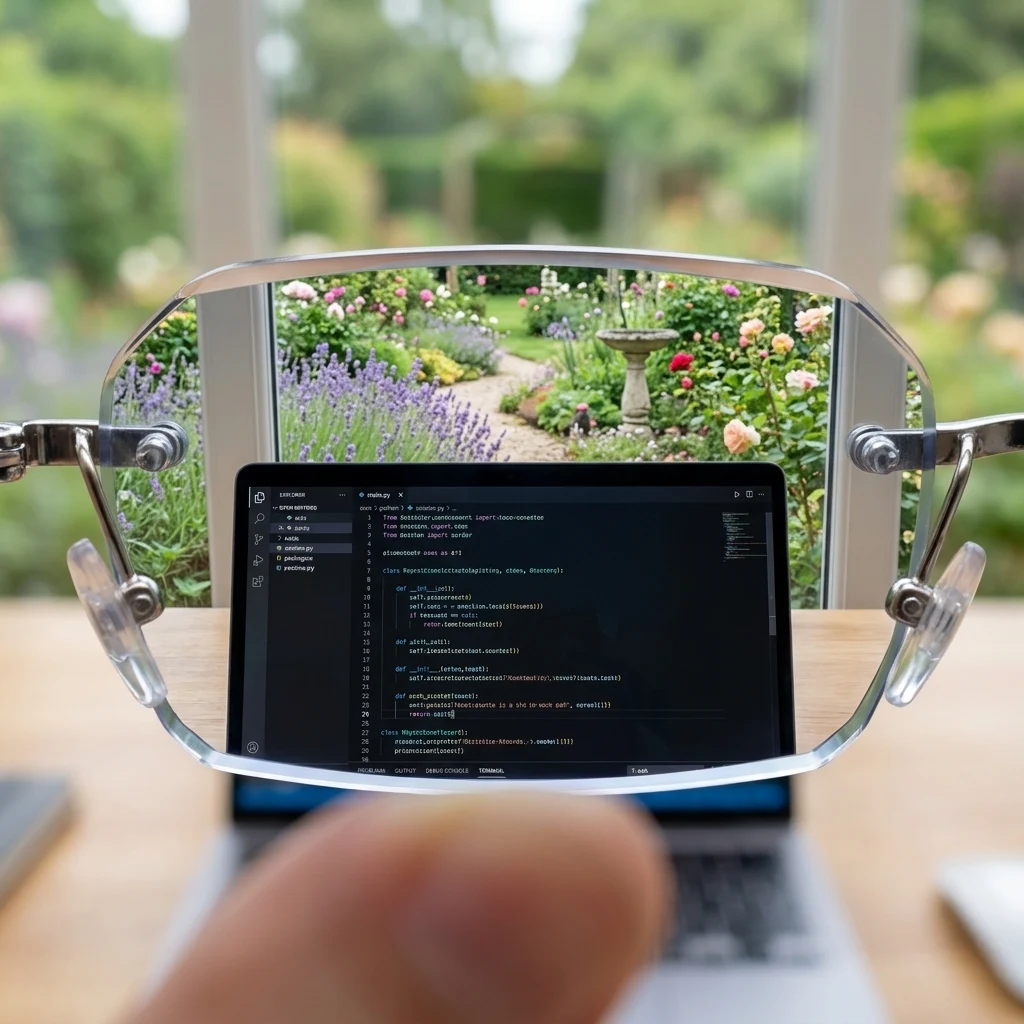
Vendor photo: a laptop screen seen through the lenses – the arm’s-length distance that single-strength readers often miss.
Reading glasses with blue light filter: what to expect
According to the vendor, BlueLume Glasses have a built-in blue light filter. Here’s the honest picture: evidence that blue light filters markedly reduce digital eye strain is limited. Many people still find a filtered lens pleasant, especially in bright offices or in the evening – and here it comes included rather than as an extra pair. Just don’t expect it to do the job of good screen habits.

Vendor photo: screen work in a bright office – where the blue light filter and the middle zone come together.
The 20-20-20 rule and two habits that really help
- 20-20-20: every 20 minutes, look at something about 20 feet away for 20 seconds. With a near-to-far pair, you don’t even have to take your glasses off – just look out of the window.
- Blink on purpose: we blink less while concentrating; a few slow, complete blinks during each break help.
- Tame the glare: match screen brightness to the room and avoid a bright window right behind the monitor.
If your eyes still feel strained after a normal screen day, or blur doesn’t go away, that’s worth an eye exam – no filter replaces one.
Transition Lenses: Where They Shine and Where They Don’t
According to the vendor, BlueLume’s lenses are photochromic: they darken in bright sunlight and clear again indoors – transition reading glasses and photochromic reading glasses in one. These lenses react to the UV part of daylight, which makes them wonderfully practical on foot and explains the few spots where they behave differently than you might expect.

Vendor photo: lenses shown darkened in bright sunshine – photochromic lenses respond to UV light.
| Situation | How photochromic lenses behave | Our tip |
|---|---|---|
| Walks, the dog’s daily round | Darken outdoors in daylight | ✓ Ideal – no switching to sunglasses |
| Patio, garden, balcony | Dark in direct sun, lighter in the shade | ✓ Near zone and tint together for reading outside |
| Errands: parking lot, store, parking lot | Darken outside, clear indoors within a few minutes | ✓ Works well – expect a short transition inside |
| Behind the car windshield | Darken only a little – windshields block most UV | ✕ No substitute for sunglasses while driving |
| Cold day vs. summer heat | Colder: darker; heat: lighter | Normal photochromic behavior |
| Dusk and night | Clear without UV | Let them clear fully – no tinted lenses for driving at dusk or night |
Put simply: transition lenses shine wherever you move on foot between indoors and outdoors and are at their weakest in the car. Per the order page, BlueLume also has a UV filter – a welcome extra for every hour outdoors. If you drive a lot on sunny days, keep a pair of sunglasses in the car.
Your 5-Minute Try-On Routine at Home
The fastest way to know whether a ready-made pair suits you is a short try-on at home with the things you really look at every day. Before you start: pick a bright room, open the box gently and set the packaging aside in one piece – the returns policy asks for pairs that come back as new in their intact original packaging.
- Minute 1 – your phone. Hold it where you normally read. Lower your eyes rather than your chin and notice where in the lens the text looks clearest.
- Minute 2 – the monitor. Sit at your usual screen distance. Can you read comfortably through the middle of the lens without tipping your head back?
- Minute 3 – the window. Look across the room and out at something far away – a house number, a tree, a street sign.
- Minute 4 – step out onto the porch. Look into the distance, then glance at your phone, and watch how the lenses begin to darken in daylight.
- Minute 5 – back inside, then decide. Watch the lenses clear and ask one question per zone: near, screen, distance – does each feel comfortable? If they clearly don’t suit you, put them back in the box right away and contact support.
Head moves, eyes rest
With any multi-zone lens, point your nose at what you want to see. When you look to the side, turn your head instead of only your eyes. For stairs and curbs, tilt your head down so you see the steps through the upper part of the lens, and use the handrail in the first days – the same tips optometrists give anyone starting out with progressive glasses.
The first days
New glasses with several zones often need a few days before they feel natural, so don’t judge in the first hour. Start with easy situations – the newspaper, the TV, a video call – and wear them for longer stretches as you go. Good light helps a lot, especially in the evening.

Vendor photo: evening reading under a lamp – good light makes the near zone easier to find in the first days.
One rule applies to any glasses: if you get headaches, feel dizzy or keep seeing blurry, stop wearing them and have your eyes checked.
Seven Everyday Moments – and Where to Look Through the Lens
An all-in-one pair earns its keep wherever near and far alternate every few seconds. Seven moments, seven quick tips – based on the typical zone layout of distance on top and reading below:

Vendor photo: reading the menu, then looking across the restaurant – a situation the vendor names itself.
- The restaurant menu: lower your gaze to read, look up to wave at the server.
- The grocery aisle: label in hand (near), price tag on the shelf (intermediate), aisle sign (far).
- Medicine labels: near zone and good light; if small print stays hard to read, ask the pharmacist rather than guess.
- The kitchen: recipe tablet at arm’s length, measuring spoon near, wall clock far.
- Hobbies: crafts and seed packets up close, and outdoors the tint handles the sun.
- On the train: book in your lap, departure board across the platform.
- TV night: the screen through the upper part, the phone in your lap through the lower part.
Driving With BlueLume Glasses: The License Question and the Tint Question
The license question. If your driver’s license carries a corrective-lens restriction, you must wear glasses that reliably give you the visual acuity your state requires. A ready-made pair with no published strength can’t guarantee that for your eyes – so with that restriction, drive only with glasses your eye-care professional has confirmed meet the requirement. Without a restriction, it’s still wise to get fully used to the zones at home and as a passenger first.
The tint question. Photochromic lenses barely darken behind a windshield, so on bright days they’re no substitute for sunglasses in the car. At dusk or night, tinted lenses have no place on a driver’s nose – let them clear fully. In the car, the zones map neatly onto the job: the road through the upper part, the dashboard through the middle; for mirrors and side traffic, turn your head.
Caring for a Rimless Frame: Cleaning, Storage and Travel
Rimless glasses look light because there’s no frame around the lenses – they’re held by small fittings at the bridge and temples. According to the vendor, BlueLume Glasses are built to withstand everyday bumps, drops and wear. A few habits keep any rimless pair straight and scratch-free:

Vendor photo: close-up of the rimless frame – fewer parts, but the lenses deserve gentle handling.
- Two hands on, two hands off – it keeps the fittings aligned.
- Rinse, then wipe: lukewarm water, a drop of mild dish soap, a microfiber cloth. Skip the shirt hem, paper towels and household cleaners.
- Never lens-down – rest them on the temples or, better, in a hard case.
- Avoid heat: not on the dashboard or next to a heater.
- Not on top of your head – it stretches the temples over time.
- Travel: case in your carry-on, not loose in a pocket with keys.
Who BlueLume Glasses Suit – and When an Eye Exam Comes First
Two checklists help you see whether ready-made glasses are the right tool for you.

Vendor photo: a home-office desk – papers, screen and window in one setting.
A great fit if …
- you’re over 40, keep reaching for readers and have no prescription or diagnosed eye condition;
- you’re tired of swapping pairs between phone, screen, room and outdoors;
- you spend time outside and like lenses that darken on their own;
- you work at a screen and want a blue light filter that also covers the middle distance;
- you value light glasses – under one ounce and rimless, according to the vendor;
- you’d like affordable spares for your bag, the office or the nightstand.
Talk to an eye-care professional first if …
- you already wear glasses or contact lenses for a prescribed correction;
- you have astigmatism or need different values left and right;
- you have a diagnosed eye condition such as glaucoma, cataract or macular degeneration;
- your vision has changed suddenly;
- your driver’s license requires corrective lenses.
Safety in brief: BlueLume Glasses are a consumer eyewear product, not a medical device, and don’t replace an eye exam. With a diagnosed eye condition, a prescription, astigmatism or different values per eye, ask your eye-care professional first. Headaches, dizziness or persistent blur: stop wearing them and have your eyes checked. Corrective-lens restriction on your license: drive only with glasses that reliably meet the required acuity. No tinted lenses at dusk or night. Sudden changes in vision belong with an eye doctor right away.
And regardless of which glasses you choose: from 40 on, regular eye exams are worth it because they check more than sharpness – eye pressure and the retina, for example. No pair of glasses does that job.
Blue Lume Glasses Reviews Score: Why We Rate BlueLume 8.6 out of 10
We rated six criteria on a 10-point scale, based on the vendor’s information, the US order page, the written policies and general optometry knowledge. The average is 8.6/10 – our “Very good” range.
Everyday versatility – 9.1. According to the vendor, BlueLume covers all four jobs on our list – near, intermediate, far and light – in one frame.
Wearing comfort & weight – 9.2. Under one ounce and rimless, per the US product page – a pair made to be forgotten on your nose. The score reflects the vendor’s specifications and the plausibility of a light rimless design, not wear of our own.
Extra features – 8.9. Photochromic lenses, blue light filter and UV filter come included. Small deduction for the natural limits of transition lenses in the car and the modest evidence on blue light filters.
Near/far viewing comfort – 7.6. Sound concept, but a ready-made pair: no individual prescription, no strength selection, no published technical data. How well the zones suit you depends on your eyes – hence the realistic sub-score.
Value for money – 9.0. $44.43 for one pair and $35.54 a pair in the 5-pack, for glasses that cover several categories – close to drugstore-reader prices for a far broader package.
Service & policies – 7.9. 90-day money-back guarantee, written returns policy, e-mail support with a 24-hour reply target and tracked shipping. Deduction because returns need an RMA number and new, unworn pairs in the original packaging.
What we like
- One light pair instead of a case collection – near, screen and distance, according to the vendor
- Photochromic lenses that darken outdoors and clear again indoors
- Blue light filter plus UV filter included at no extra cost
- Nothing to charge: no battery, no cable, no electronics
- Under one ounce with a slim rimless frame (vendor)
- No prescription and no appointment needed
- From $35.54 a pair in the 5-pack, $39.99 in the 3-pair deal
- 90-day money-back guarantee, plus a 10-year warranty mentioned on the product page
- No pre-ticked extras; pay by credit card or PayPal
- Tracked shipping from a US warehouse (vendor)
Good to know
- No individual prescription and no published diopter data
- A few days to get used to the zones is normal
- Returns only as new, in the original packaging, with an RMA number
- Doesn’t replace an eye exam
Blue Lume Glasses Reviews and Complaints: How to Read Them
Search for “blue lume glasses reviews and complaints” or “blue lume reviews” and you’ll find the vendor’s own pages, ads and forum threads – each deserves a different kind of reading.
Customer voices on the vendor’s pages
The product page and the vendor’s advertorial pre-page show customer stories, star ratings and big numbers. These are vendor-published statements we can’t verify, so we don’t repeat ratings, counts or names. The pre-page itself says it is an advertisement and that all people shown are models, and a footer note says the press logos shown “do not imply endorsement”. Read these voices as marketing that shows how the glasses are meant to be used.
What complaints about this product type are usually about
- Getting used to the zones. Normal for a few days with any multi-zone glasses – the try-on routine and the “point your nose” habit help.
- Expectations about strength. A ready-made pair has no strength selection. If your eyes need a specific correction, an optometrist is the right address.
- Tint in the car. Photochromic lenses barely darken behind a windshield – good to know in advance.
- Return conditions. New, unworn pairs in the original packaging, RMA number first – keep the box and write to support early.
Consumer Reports and marketplace stars
Consumer Reports hasn’t published a review of BlueLume Glasses, and we know of no independent lab review. Forum posts are unverified, and star ratings on marketplaces may belong to other glasses, since BlueLume isn’t sold there officially. That’s why our 8.6 is an editorial assessment – and why the best complement to any Blue Lume glasses reviews, this one included, is your own five-minute try-on at home.
Are Blue Lume Glasses a Scam or Legit? Company, Policies and Where to Buy
Short answer to “are Blue Lume glasses a scam?”: everything we reviewed points to a legitimate online shop. Bold advertising on the pre-page is a reason to read claims carefully – it doesn’t make a shop a scam.
- Written Terms of Service, privacy policy and Returns & Exchange Policy
- PayPal alongside major credit cards; no pre-ticked extras
- Tracked shipping with a tracking link by e-mail
- E-mail support with stated hours and a reply target
- An honest footer: not a medical device, no replacement for an eye exam
Who is behind BlueLume Glasses?
The shop brand is Lensera (© 2026 Lensera), and support runs through support@shoplensera.com – Monday to Friday, 9 am to 5 pm, with replies targeted within 24 hours. The US site has no imprint page, but its contact page lists company details for BlueLume Glasses in Metro Manila, Philippines, and the Terms of Service are governed by Florida law. The German version of the shop names Apex Marketing Ltd in Hong Kong as the operator of Lensera.
Blue Lume glasses on Amazon, Walmart, Target or CVS?
Searches like “blue lume glasses amazon” or “blue lume glasses for sale” show how many people expect a big retailer. BlueLume is a direct-to-consumer brand: we found no official offer on Amazon, at Walmart, Target, Costco, CVS or Walgreens, or at optical chains. The pack prices and the 90-day guarantee in this guide refer to the official shop.
To get the original 2026 version, order directly from the official BlueLume website.
BlueLume Glasses Price: $44.43 for One Pair, Down to $35.54 a Pair
BlueLume Glasses come in packs of one to five pairs. These are the prices we saw on the US order page on November 17, 2026, in US dollars with the country set to United States. The discount was already applied in the cart – no code to enter. Reference prices and discount labels are the vendor’s.
The 3-pair deal is the one we’d pick: $39.99 instead of $44.43 a pair, enough for the nightstand, the desk and your bag – no more hunting for your glasses around the house. Buying for two, or want a spare in every room? The 4- and 5-packs bring the price per pair down further.
| Pack | Price | Per pair | Vendor reference price | Discount (vendor) | Per pair per day* |
|---|---|---|---|---|---|
| 1 pair | $44.43 | $44.43 | $88.86 | 50% | about 12 cents |
| 2 pairs (“most popular”) | $84.42 | $42.21 | $179.62 | 53% | about 12 cents |
| 3 pairs (“best deal”) | $119.97 | $39.99 | $266.60 | 55% | about 11 cents |
| 4 pairs | $151.08 | $37.77 | $359.71 | 58% | about 10 cents |
| 5 pairs | $177.70 | $35.54 | $444.25 | 60% | about 10 cents |
*Price per pair divided by 365, if one pair is worn every day for a year. Prices checked on November 17, 2026 in the US cart; they may change.
Shipping, sales tax and payment
In the cart we walked, the Grand Total matched the package price exactly, with no separate shipping line; a note on the order page says shipping and tax are settled upon checkout confirmation, so glance at the final summary before you confirm. Depending on your state, sales tax may apply. You can pay by Visa, Mastercard, American Express, Discover or PayPal, and the order page also shows Apple Pay and Google Pay logos. Besides the United States, the US checkout ships to Canada, the United Kingdom, Ireland, Australia, New Zealand and France.
Ordering Step by Step – Plus Shipping and the 90-Day Guarantee
The path we walked on the US order page – every package selected, nothing ordered:
- Open the official shop via one of the buttons in this guide.
- Click “Order Now. Save 50% Off” on the product page to reach the checkout.
- Choose your pack – 1 to 5 pairs; the Grand Total updates with each choice.
- Enter your address – the only pre-ticked box is “use shipping address as billing address”. No pre-ticked extras.
- Pay by credit card or PayPal.
- Bonus offers (optional) – the progress bar reads “Checkout → Bonus offers → Summary”. The add-on page after payment is optional; take something only if you really want it.
- Summary and tracking – the tracking link follows by e-mail once your parcel ships.
How long does shipping take?
According to the product page, orders are dispatched within two business days from the vendor’s US warehouse, followed by two to three days of standard delivery. The Terms of Service add that processing typically takes one to two business days and most orders arrive three to seven business days after shipment – so plan with about a week.
The 90-day money-back guarantee – friendly ordering tips
BlueLume advertises a 90-day money-back guarantee, summed up on the order page like this: “Simply send the item(s) back in the original packaging to receive a full refund or replacement, less S&H.” The product page also mentions a 10-year warranty; its conditions aren’t described in the returns policy, so ask support if that matters to you.
The written Returns & Exchange Policy fills in the details: 90 days from receipt; pairs should come back brand new, unworn and in intact original packaging; contact customer service first for an RMA number and the return address; refunds go to the original payment method, and a 10% restocking fee may be charged. Damaged goods are replaced with proof of the defect within 14 days, and for non-defective products the policy is most generous within the first 14 days. There’s also a “100% satisfaction guarantee” with an exchange offer.
- Read the policy once before ordering and keep the box intact until you’re sure.
- Try them on carefully at home – the five-minute routine is made for exactly that.
- Decide early – if they’re not for you, write to support@shoplensera.com within the first days and ask for your RMA number.
Your Questions About BlueLume Glasses – Answered in Brief
What are Blue Lume glasses?
Ready-made, rimless glasses sold online under the shop brand Lensera. According to the vendor, they combine near-to-far viewing, photochromic lenses and a blue light and UV filter – no prescription, no battery.
How do Blue Lume glasses work?
Without electronics, a lens can’t change its power by itself. No-battery near-and-far glasses normally use viewing zones: straight ahead for distance, lower for reading. BlueLume doesn’t publish its exact lens design.
Do Blue Lume glasses really work?
The principle is sound and well known. How well a ready-made pair suits you depends on how closely its zones match your eyes – check with our five-minute try-on and allow a few days to get used to them.
Are BlueLume Glasses self-adjusting or autofocus glasses?
The vendor calls them “self-adjusting”, but they aren’t electronic autofocus glasses: no battery, no sensor, nothing to charge. The “adjusting” happens as your gaze moves through the lens.
Do I need a prescription – and can I choose a strength?
No prescription is needed, and there’s no strength selection; no diopter values are published. With a prescription, astigmatism or different values per eye, ask your eye-care professional first.
Can they replace my reading glasses, distance glasses and sunglasses?
That’s what they’re meant to do, according to the vendor. They don’t replace individually fitted prescription glasses or an eye exam, and in the car you’ll still want sunglasses.
Do the transition lenses work in the car?
Only a little – windshields block most of the UV light that makes photochromic lenses darken. On walks, the patio or errands they work as intended.
Does the blue light filter help with screen time?
Evidence that blue light filters markedly reduce digital eye strain is limited, though many people find them pleasant. Proven helpers: the 20-20-20 rule, conscious blinking and a screen at arm’s length.
Can I drive with BlueLume Glasses?
With a corrective-lens restriction, only with glasses your eye-care professional confirms meet the required acuity. Get used to the zones first, and never drive with tinted lenses at dusk or night.
Are Blue Lume glasses a scam or legit?
Legit, based on everything we reviewed: written terms and returns policy, PayPal, tracked shipping, e-mail support and an honest footer.
Who makes them, where are they shipped from and how long does delivery take?
The shop brand is Lensera; the US contact page lists company details in Metro Manila, Philippines. According to the product page, orders leave a US warehouse within two business days, followed by two to three days of standard delivery; the terms say most orders arrive three to seven business days after shipment.
Can I buy Blue Lume glasses on Amazon, at Walmart or at CVS?
We found no official offer there, nor at Target, Costco, Walgreens or optical chains. BlueLume Glasses are sold through the official website.
How much do BlueLume Glasses cost?
In the US cart: $44.43 for one pair, $84.42 for two, $119.97 for three, $151.08 for four and $177.70 for five ($35.54 a pair). The discount is applied automatically.
What is the return policy?
A 90-day money-back guarantee. Contact support for an RMA number first and return new, unworn pairs in their intact original packaging; a 10% restocking fee may be charged. Decide early and keep the box.
Has Consumer Reports reviewed Blue Lume glasses?
No, and we know of no independent lab review. Our 8.6/10 is an editorial assessment.
Our Verdict: One Featherweight Pair for Most of Your Day
After working through the vendor’s pages, the US order page and the policies, our conclusion is positive: BlueLume Glasses pack near-to-far viewing, transition lenses and a blue light and UV filter into one rimless pair under one ounce – with nothing to charge and no prescription needed. For people over 40 who keep juggling readers, computer glasses and sunglasses, that’s a genuinely attractive way to simplify the day. It doesn’t replace individually fitted glasses or an eye exam – but for the everyday mix of phone, screen, room and sunshine, the concept is smart and the price is fair.
That’s why BlueLume earns 8.6 out of 10 and our recommendation. If Blue Lume glasses reviews brought you here wondering whether one pair can do it all: choose the 3-pair deal at $39.99 a pair, put one on the nightstand, one on the desk and one in your bag, and run the five-minute try-on the day they arrive. With the 90-day money-back guarantee behind you, it’s an easy decision.
Transparency notice: This product check contains affiliate links. If you buy through them, we may earn a commission at no extra cost to you; it doesn’t affect our score. Our rating is an editorial assessment based on the vendor’s product page and FAQ, the US order page walked on November 17, 2026, the Terms of Service, the Returns & Exchange Policy, the company details and general optometry knowledge. It is not a lab test and not based on wearing the glasses ourselves or on an eye exam. Vendor claims are marked as such; photos are official vendor images. Prices (US checkout, US dollars, November 2026) may change. Safety notice: BlueLume Glasses are a consumer eyewear product, not a medical device, and do not replace a professional eye exam. With a diagnosed eye condition, a prescription, astigmatism or different values per eye, ask an eye-care professional first. Headaches, dizziness or persistent blur: stop wearing them and have your eyes checked. With a corrective-lens restriction on your license, drive only with glasses that reliably meet the required acuity; no tinted lenses at dusk or night. Sudden changes in vision: see an eye doctor promptly.
